AI agents are rapidly growing, so it becomes more intelligent. Memory has become one of the most important components of modern AI systems.
Using memory AI models can respond to current as well as previous prompts. They cannot remember previous conversations, maintain context across sessions, or make decisions based on the historical data without using memory. So, AI memory architecture comes in to provide the better results.
AI memory architecture provides organize, store and retrieve information efficiently. It powers everything from chatbot and coding assistants to autonomous AI agents.
In this guide, you’ll learn how AI memory works, the different memory types, architecture, and best practices for building memory-enabled AI applications.
Table of Contents
- What Is AI Memory Architecture?
- Why Memory Matters in AI Systems
- Types of AI Memory
- AI Memory Architecture Components
- How AI Memory Works
- Memory Storage Technologies
- AI Memory in Agentic AI
- AI Memory vs Traditional Databases
- Common Challenges
- Future of AI Memory
- FAQs
- Conclusion
What Is AI Memory Architecture?
AI Memory Architecture refers to design and implementation of the systems that allows AI applications to store, retrieve information history data.
Memory AI systems enable:
- Remember previous context
- Maintain conversational context
- Store knowledge
- Improve decision-making
- Improve user experience
memory creates continuity and intelligence for every conversation so that system give the better results.
Why Memory Matters in AI Systems
Imagine an AI coding assistant, after every message forgets everything so result will not be accurate and consistent so Memory in AI system is the key component for context.
Without memory the assistant would need:
- Give same instructions again
- Repeated project context
- Repeated coding standards
This creates a poor user experience.
Memory allows AI systems to:
- Retain context
- Improve task completion
- Enable autonomous agents
- Enable long session workflows
Types of AI Memory
Short-Term Memory
Short-term memory stores only the recent conversation information.
Examples:
- Current conversation
- Temporary store the task information
Characteristics:
- Limited storage memory
- Store Session-based conversation data
- Fast access
Long-Term Memory
Long-term memory stores conversation data across sessions.
Examples:
- Historical conversations
- User personalized information
Characteristics:
- Persistent storage
- Large capacity to store the information
- Historical context data
- Fast access
Semantic Memory
Semantic memory stores the knowledge informations.
Examples:
- Company policies
- Product documentation and design
- Technical knowledge of the topic
Episodic Memory
Episodic memory stores experiences and events.
Examples:
- Previous user actions
- Task execution history
Procedural Memory
Procedural memory stores process and set of task information.
Examples:
- Workflow definitions and process
- Automation rules
AI Memory Architecture Components
A modern AI memory system typically includes:
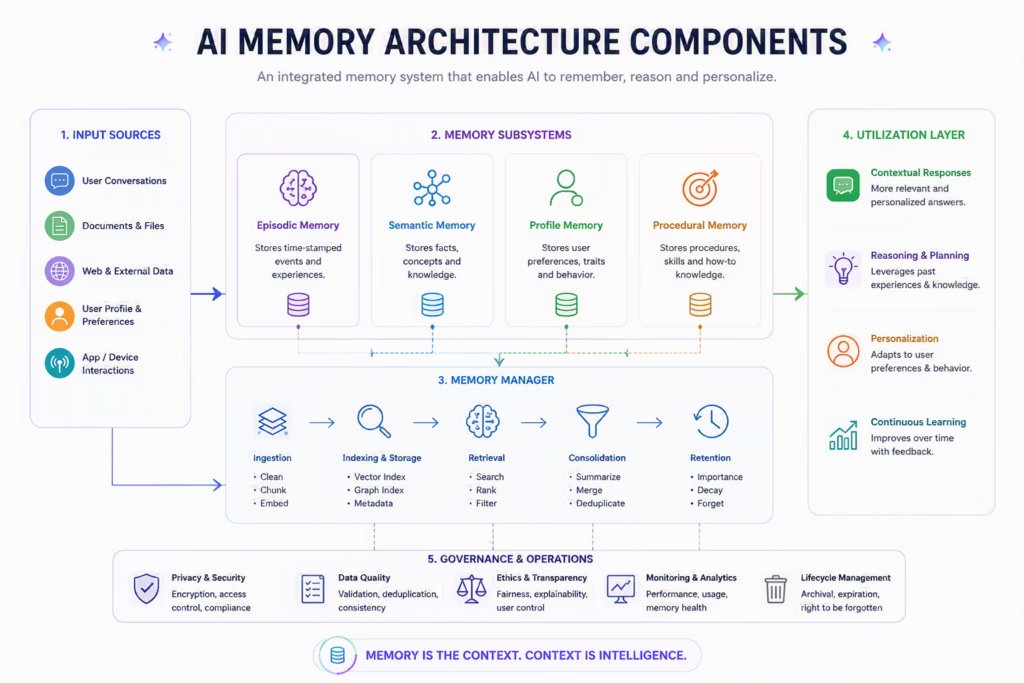
Core components include:
Working Memory
Maintains current active context informations.
Retrieval Layer
Fetches relevant information from the vector database
Long-Term Storage
Stores persistent knowledge.
Memory Manager
Maintain the storage and retrieval of the information
How AI Memory Works
The memory lifecycle generally follows these steps:
Step 1: Capture Information
The system receives new user query.
Step 2: Process Content
Key information is extracted from the user query.
Step 3: Generate Embeddings
Extracted information convert into embeddings for vector representation.
Step 4: Store Memory
Data is saved in a memory storage.
Step 5: Retrieve Relevant Context
The system retrieves relevant information from the vector database when it is needed.
Step 6: Enhance Responses
Retrieved memory improves reasoning and decision-making.
Memory Storage Technologies
AI memory systems commonly use:
Vector Databases
Popular options:
- Pinecone
- Chroma
Benefits:
- Semantic search
- Fast retrieve information
Relational Databases
Examples:
- PostgreSQL
- MySQL
Used for:
- User profiles
- Transaction information
- Structured information
Knowledge Graphs
Benefits:
- Relationship mapping
- Contextual understanding
AI Memory in Agentic AI
Agentic AI systems entirely depend on memory.
Memory enables agents to:
- Track goals
- Remember tasks
- Coordinate actions
- Collaborate with other agents
- Make decisions based on the context
Without memory, Agentic AI becomes less effective and give the wrong outcomes.
AI Memory vs Traditional Databases
| Feature | Traditional Database | AI Memory |
| Exact Matching | Yes | Limited |
| Semantic Search | No | Yes |
| Context Awareness | No | Yes |
| User Personalization | Limited | Advanced |
| Retrieval Intelligence | Basic | Advanced |
Common Challenges
Memory Drift
Stored information becomes outdated. There is no significant use of the outdated memory.
Retrieval Noise
Irrelevant information is returned from the database.
Storage Costs
Large memory system requires more resources.
Privacy Concerns
Sensitive information and security must be protected.
Future of AI Memory Architecture
Several trends are shaping the future:
- Persistent AI Agents
- Multi-Agent Memory Sharing
- Self-Optimizing Memory Systems
- Memory-Aware LLMs
As Agentic AI adoption increases, memory architecture will become a critical part of AI system design.
Frequently Asked Questions
What is AI Memory Architecture?
AI Memory Architecture is the framework that enables AI systems to store, retrieve, and utilize information over time.
Why is memory important for AI agents?
Memory helps AI agents maintain context, learn from interactions, and complete long-running tasks effectively.
What are the main types of AI memory?
Short-term memory, long-term memory, semantic memory, episodic memory, and procedural memory.
Which databases are used for AI memory?
Vector databases such as Pinecone, Weaviate, Milvus, and Chroma are commonly used.
How does memory improve AI performance?
Memory provides context, personalization, and historical knowledge that enhance decision-making and response quality.
Conclusion
AI Memory Architecture is becoming core component of the modern AI systems. Developers should learn and understand the memory architecture to build AI agents, RAG systems, for modern AI applications.
From coding assistant to autonomous workflow, enterprise AI applications, memory architecture is playing critical role in modern AI system.