Artificial Intelligence has growing rapidly over the last few years. In modern AI system known as Agentic AI is changing how software communicates with outer world.
While Traditional AI helping on the answer questions, assist users with specific task using chatbot but modern Agentic AI is using the tools , plan actions, make the decisions dynamically and give the efficient response with minimal human intervention.
In this guide, you’ll learn what Agentic AI is, how it works, its architecture, benefits, challenges, and real-world applications for developers.
Table of Contents
- What Is Agentic AI?
- Why Agentic AI Matters
- How Agentic AI Works
- Core Components of Agentic AI
- Agentic AI Architecture
- Agentic AI vs Traditional AI
- Benefits of Agentic AI
- Real-World Use Cases
- Popular Frameworks
- Challenges and Risks
- Future of Agentic AI
- Frequently Asked Questions
- Conclusion
What Is Agentic AI?
Agentic AI is automation system that can independently plan, tools call, reason, make decisions, and execute actions to give the better and optimized response.
Agentic AI can:
- Analyse goals
- Divide complex tasks into smaller task
- Use external tools
- Access databases and APIs
- Optimized result
- Make decision dynamically
For example:
A traditional AI assistant might answer:
“How do I book a flight ticket ?”
An Agentic AI system can:
- Search flights
- Compare prices and select the cheap cost flight
- Complete the booking ticket process
- Send confirmation to Email or WhatsApp.
without requiring user guidance.
Why Agentic AI Matters
All software companies want that productivity should increase so Agentic AI is the most critical system for that.
Organizations are looking for AI systems that can:
- Improve productivity
- Reduce cost
- Assist developers
- Automate software applications
Agentic AI addresses these above requirements by enabling AI systems to act rather than simply respond.
Industries are adopting these capabilities including:
- Software Development
- Customer Support
- Healthcare
- Finance
- E-commerce
- Cloud Operations
How Agentic AI Works
Agentic AI follows a continuous cycle:
Goal -> build spec -> reasoning -> Tool calls-> Execution -> Evaluation -> optimization
The system continuously evaluates the results and repeats this process until the goal is achieved.
Core Components of Agentic AI
1. Large Language Models (LLMs)
LLM provides the natural language understanding capabilities. So that human can easily interact with the AI system.
Examples include:
- OpenAI Models
- Anthropic Models
- Google Models
- Llama Model
2. Memory
AI system persist the chat context across interactions using the memory .
Memory types include:
- Short-Term Memory
- Long-Term Memory
- Vector-Based Memory
3. Planning Engine
It breaks down the complex task into the small task and execute them to achieve the goal.
Example:
Goal: Deploy an application.
Tasks:
- Build application
- Run test cases
- Create deployment yaml or spec configuration
- Deploy to cloud
- check health of the system
4. Tool Integration
Agentic AI systems can interact with:
- Databases
- APIs
- External file systems
- Cloud Services
With the help of MCP AI System can communicate with them.
5. Feedback Loop
An AI system continuously verifies the results and performs actions repeatedly until the requirements are met.
This enables more reliable autonomous behaviour.
Agentic AI Architecture
A typical Agentic AI architecture consists of:
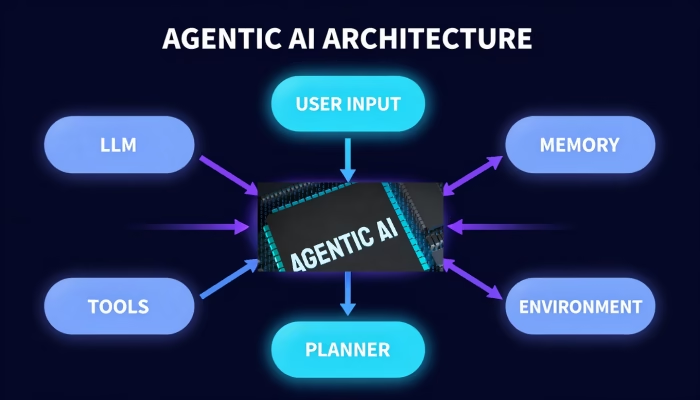
The agent acts as an orchestrator that coordinates reasoning, memory, and external resources.
Agentic AI vs Traditional AI
| Feature | Traditional AI | Agentic AI |
| Responds to Prompts | Yes | Yes |
| Goal-Oriented | Limited | Yes |
| Multi-Step Reasoning | Limited | Advanced |
| Tool Usage | Basic | Extensive |
| Autonomous Execution | No | Yes |
| Planning Capability | Minimal | Advanced |
| Decision Making | Limited | Dynamic |
Benefits of Agentic AI
Improve Productivity
Agentic AI can automate the task so effort will be reduce and improve the productivity of software workflow.
Better Decision-Making
AI systems can evaluate multiple options and recommend optimal actions.
Reduced Costs
Automation reduce the effort and time for repetitive work so improve the efficiency.
Improved Customer Experience
AI agents can provide personalized support.
Scalability
Companies can handle larger workloads without increasing the employees.
Real-World Use Cases
Software Development
Agentic AI can:
- Generate code
- Review pull requests
- Create features
- Create documentation
- Fix bugs
- Run tests
Customer Support
AI agents can:
- Answer questions
- Resolve tickets
- Access customer records
Cloud Operations
Agentic AI can:
- Monitor and create infrastructure
- Detect issues
- Scale resources
- Observations and logs
- Optimize cloud costs
Popular Frameworks for Agentic AI
Developers use:
- LangGraph
- LangChain
- OpenAI Agents SDK
These frameworks simplify building multi-agent systems and autonomous workflows.
Challenges and Risks
While Agentic offers benefits we should address some challenges and risks.
Security
AI systems require strong security controls. So that tools can access resources without any security concern.
Hallucinations
Incorrect reasoning can lead to poor decisions.
Cost
Autonomous workflows can increase the cost of the usage resources.
Governance
Organizations must ensure AI systems operate within defined policies.
The Future of Agentic AI
AI is expected to become the key component of the software applications.
Future developments may include:
- Autonomous Software Development
- AI-Powered Cloud Operations
- Multi-Agent Collaboration
Organizations that adopt Agentic AI early can gain competitive advantages.
Frequently Asked Questions
What is Agentic AI?
Agentic AI refers to AI systems that can autonomously plan, reason, and execute actions to achieve goals.
How is Agentic AI different from traditional AI?
Traditional AI responds to prompts, while Agentic AI can independently plan and perform multi-step tasks.
What are AI agents?
AI agents are software systems that use reasoning, memory, and tools to accomplish objectives autonomously.
Is Agentic AI the future of automation?
Many experts believe Agentic AI will play a major role in future business automation and software systems.
Which industries use Agentic AI?
Industries such as software development, healthcare, finance, customer support, and cloud computing are adopting Agentic AI.
Conclusion
Agentic AI uses reasoning, planning, memory, and tool integration. With these capabilities, it can perform tasks autonomously.
For developers Agentic AI is becoming more important as organizations uses the AI agents, autonomous workflows. Any Application that you are building such as cloud applications, AI assistant applications, or enterprise Software’s Agentic AI will play critical roles for technology.