Artificial Intelligence is changing the software application in terms of interact with data and other external services. REST APIs is the standard communication for the web application for over two decades. Now a new protocol introduced which is know as Model Context Protocol. it is mostly preferred choice for AI applications.
In this guide, we’ll explore MCP vs REST API, explore their architectures, advantages, disadvantages, and which is better to build the AI-powered applications.
Table of Contents
- What Is REST API?
- What Is MCP?
- MCP vs REST API: Quick Comparison
- Architecture Differences
- Advantages of REST API
- Advantages of MCP
- When to Use REST API
- When to Use MCP
- Real-World Examples
- Future of AI Integrations
- FAQs
- Conclusion
What Is REST API?
REST(Representational State Transfer) is architectural style that helps to communicate with front end application using the HTTP Protocol. There are standard methods such as:
- GET
- POST
- PUT
- DELETE
- PATCH
REST APIs expose their methods so that client can call to update/modify the data.
Example
GET Method:  /users/45628912

Response:

[{

  "id": 45628912,

  "name": "John Doe"

},{

  "id": 45628913,

  "name": “Joe Applebee"

}]
REST APIs are widely used in:
- Web Applications
- Mobile Applications
- E-commerce Applications
- Enterprise Applications
What Is MCP?
Model Context Protocol (MCP) is an open standard designed that is used for the AI Systems and Models. It provides the connection between the Apps and Large Language Models.
MCP servers provide tools, resources, prompts, and capabilities that Model can use dynamically to gather the informations.
Think of MCP as a USB-C connector for AI applications.
Instead of manual Api integration , AI agents connects to the MCP server and server provides the resources ,tools to get the information’s.
Example MCP Capabilities
An MCP server might expose:
- Database Access
- GitHub Repositories
- CRM Data
- Email Services
- JIRA Atlassian tool
An AI agent can lookup these tools and invoke them without custom integrations.
MCP vs REST API: Quick Comparison
| Feature | REST API | MCP |
| Purpose | Application Communication | AI Model Communication |
| Discovery | Manual Documentation | Automatic Discovery |
| Integration | Endpoint Based | Tool Based |
| AI Friendly | Limited | Native Support |
| Context Awareness | No | Yes |
| Dynamic Tool Usage | No | Yes |
| Schema Understanding | Partial | Built-in |
| Agent Support | Difficult | Excellent |
| Learning Curve | Easy | Moderate |
| Future AI Readiness | Medium | High |
Architecture Differences
REST API Architecture
Client -> Send request via HTTP Request -> REST Endpoint (Method) -> Backend Business logic -> Database
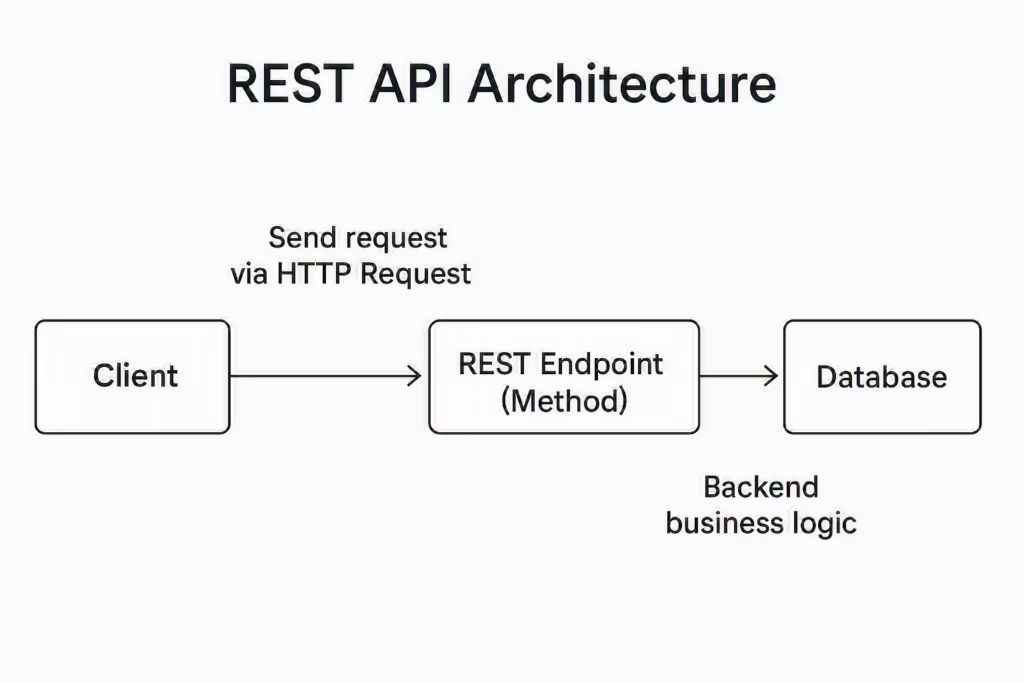
The client must know:
- Endpoint URL
- Request payload
- Authentication Method
- Response Format
MCP Architecture
AI Agent -> MCP Client -> MCP Server -> Available Tools & Resources ->External Systems
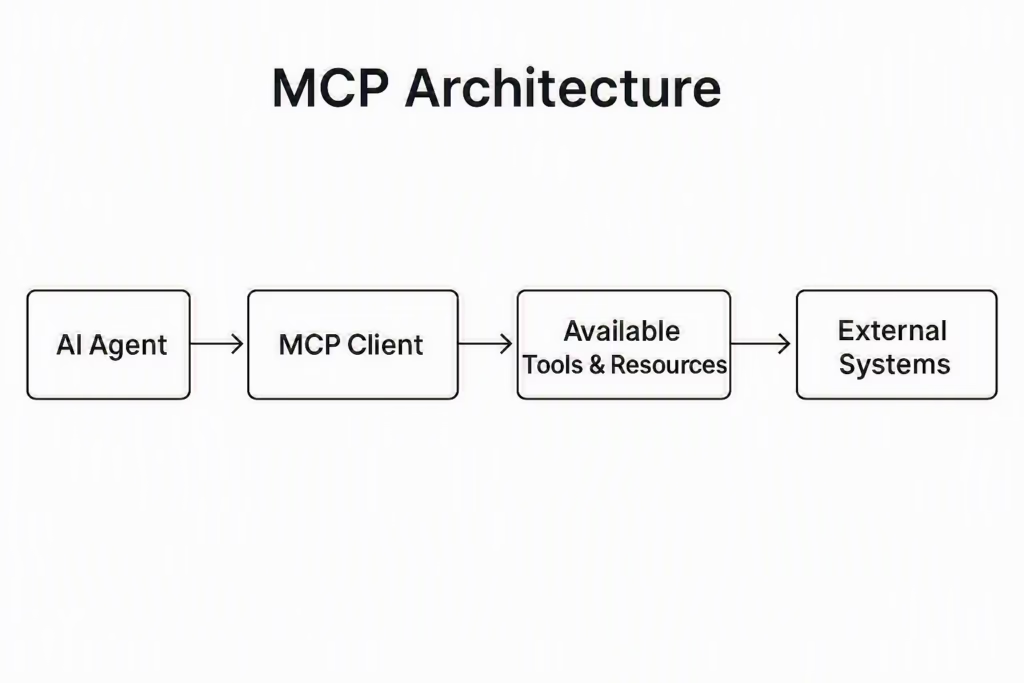
The AI model can:
- Dynamic search available tools
- Understand tool schemas
- Execute tools action dynamically
- Maintain contextual understanding
So this makes MCP perfect for AI applications.
Advantages of REST API
REST API is standard communication for the client applications.
1. Mature Ecosystem and Community
Every programming language supports the REST Architecture.
Examples:
- Java
- Node js
- Next Js
- .NET
- Python
2. Easy to Learn
Developers can quickly learn to build the API in rest architecture using existing framework.
3. Massive Tooling Support
Popular tools include:
- Swagger
- Postman
- Insomnia
4. Excellent Scalability
REST APIs power:
- Amazon
- Netflix
- Hotstar
- Spotify
- Shopify
- Flipkart
Advantages of MCP
MCP specifically designed for AI systems.
1. Native AI Integration
AI Model understands the MCP tool dynamically so that no endpoint mapping is required.
2. Dynamic Tool Discovery
The model can discover:
- Available actions or tools
- Input parameters
- Expected outputs
without hardcoding.
3. Context-Aware Interactions
MCP maintains more contextual information than traditional APIs.
4. Faster AI Agent Development
Developers can do quickly integration.
5. Standardized AI Communication
It is standardized communication to connect AI system
When Should You Use REST API?
REST is better choice when building:
Web Applications
Examples:
- E-commerce Websites
- Banking Applications
- CMS Platforms
Mobile Apps
Android and iOS applications rely heavily on REST.
Public APIs
third-party services expose REST endpoints.
Microservices
REST remains a strong choice for service-to-service communication.
When Should You Use MCP?
MCP is better when building:
AI Agents
Examples:
- Customer Support Bots
- Chat Assistant
- Coding Assistants
Multi-Agent Systems
Agents can collaborate through shared tools.
AI Workflows
Complex AI application becomes easier to automate.
Enterprise AI Platforms
Companies can expose internal systems through MCP servers.
Real-World Example
Imagine an AI Sales Assistant.
Using REST APIs
The developer must:
- Connect CRM API
- Connect Email API
- Connect Calendar API
- Connect Analytics API
Every integration required the code setup.
Using MCP
The AI agent connects to one MCP server.
The server provides:
- CRM Tool
- Email Tool
- Calendar Tool
- Analytics Tool
The model searches this tool automatically.
Result:
- Faster Development
- Less Maintenance
- Scalability and Better Performance
Future of AI Integrations
The rise of:
- AI Agents
- Autonomous workflow
- Enterprise AI chatbot
- Multi-Agent
is leading demand for MCP.
As AI becomes core part of the software application, so MCP server adoption is expected to grow in future.
Frequently Asked Questions
Is MCP better than REST API?
Not necessarily. REST is better for traditional application communication, while MCP is better for AI-powered systems and intelligent agents.
Can MCP replace REST APIs?
No. MCP usually works alongside REST APIs rather than replacing them.
Is MCP difficult to learn?
Developers familiar with APIs can learn MCP relatively quickly.
Why are AI companies adopting MCP?
Because it standardizes how AI models discover and use external tools.
Should startups use MCP?
If you’re building AI agents or AI-powered workflows, MCP can significantly reduce integration complexity.
Conclusion
The MCP vs REST API debate is not about the replacing the other technology.
REST APIs is standard architecture for software application, while MCP server provides standard designed for AI applications.
Choose REST API if you’re building web, mobile or enterprise level applications.
Choose MCP if you’re building AI agents, autonomous workflows, or enterprise AI platforms.
We can combine both technologies to build the scalable application using the REST and intelligence of MCP for the AI era.