The AI personalization examples from top companies like Netflix and Amazon have completely transformed how users interact with digital platforms. From movie suggestions to product recommendations, AI is driving smarter and more engaging user experiences. So that user should feel better experience and fast with responses.
In this detailed guide, we’ll walk through real AI personalization examples, understand how recommendation engines works behind the scene and learn how you can implement in your own applications.
📌 Table of Contents
- What is AI personalization
- Netflix AI personalization strategy
- Amazon AI personalization strategy
- How recommendation engines work
- Tools comparison
- Benefits and challenges
What is AI Personalization?
AI personalization refer to systems that uses AI feature to generate customized content, products, or user experiences based on user action or behaviour.
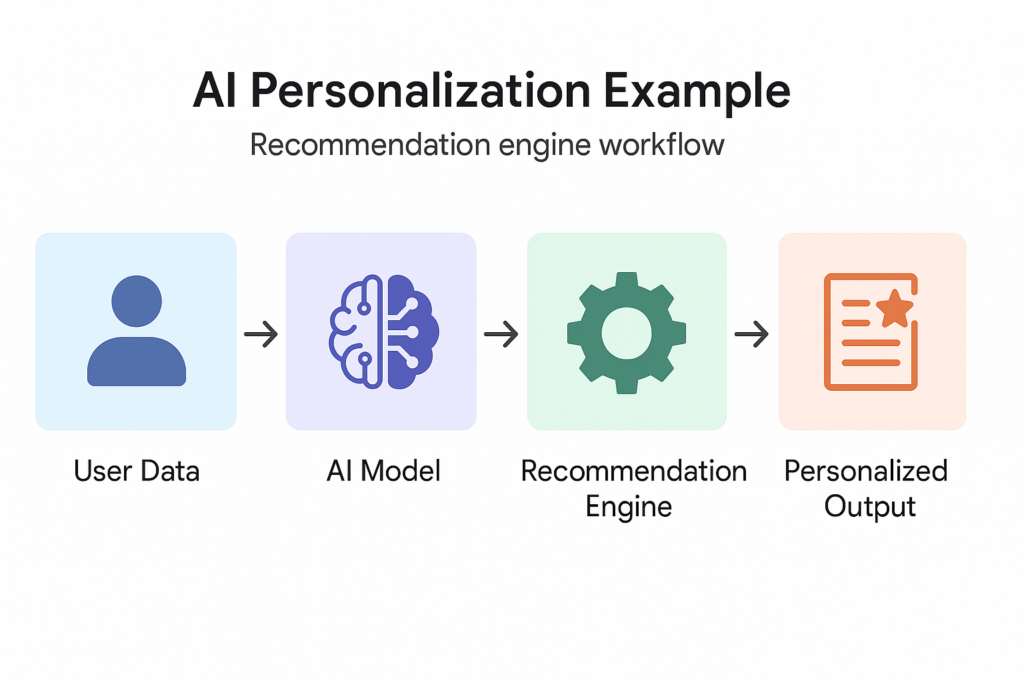
Key Components:
- User data collection (clicks, searches, watch history, logs the user activity)
- Machine learning AI models (chatgpt, ollama3.2, deepseek)
- Real-time decision-making (based on the user input AI will decide the workflow)
Instead of showing the same content to every user, AI ensures each user gets a unique and better experience.
🎬 AI Personalization Examples: Netflix Strategy
Netflix is one of the best real-world example of AI personalization. We will see how Netflix use this and working behind the scenes.
How Netflix Uses AI:
- Personalized homepage for every user
- Movie and series recommendations based on the users previous actions
- Dynamic thumbnails based on preferences
Example:
If a user watches:
- Action movies → Netflix suggests similar genres
- Romantic shows → Homepage adapts accordingly
- Horror Movies → Netflix suggests similar movies
Netflix even change dynamic thumbnails based on what attracts you most—this is advanced feature of personalization.
🛒 AI Personalization Examples: Amazon Strategy
Amazon is another most powerful example of AI-driven personalization. It also used to recommend the product that attract most.
How Amazon Uses AI:
- “Customers also bought” suggestions
- Personalized homepage recommendations
- Smart product ranking
Example:
If you search for mobiles:
- Amazon suggests accessories like covers or earphones
- Recommends similar products within your budget
This increases both user satisfaction and sales conversions.
🧠 How Recommendation Engines Work
Recommendation engines are the core component of AI personalization examples.
Step-by-Step Workflow:
- Collect user data (searches, clicks, purchases, history)
- Convert all data into patterns
- After data Analysis will get fine tuning
- Apply machine learning algorithms on the data
- Generate personalized recommendations based on the pattern
- Display results in real-time
Types of Recommendation Engines
1. Collaborative Filtering
- Recommends based on similar users
- Example: “Users like you watched this”
2. Content-Based Filtering
- Recommends similar items
- Example: Suggesting action movies if you watched one
3. Hybrid Models
- Combines both approaches
- Used by Netflix and Amazon
📊 Tool Comparison for AI Personalization
| Tool | Best For | Complexity | Use Case |
| TensorFlow | Custom ML models | High | Advanced AI systems |
| Amazon Personalize | Recommendation engine | Medium | E-commerce apps |
| Google AI | Scalable AI solutions | Medium | Enterprise applications |
| PyTorch | Deep learning research | High | AI experimentation |
🚀 Benefits of AI Personalization
Using AI personalization in your app provides:
- Higher user engagement
- Better customer experience
- Increased conversions
- Improved retention rates
- Application response will be fast.
⚠️ Challenges of AI Personalization
Despite its benefits, there are challenges:
- Data privacy concerns issues
- Cold start problem (new users)
- High implementation cost
- Requires large datasets
- Learn Advance machine learning
📈 How to Build Your Own AI Personalization System
Step-by-Step:
- Collect user interaction data like clicked , search. events
- Store data in database/vector database
- Use ML models for prediction and trained the Models based on the prediction data
- Implement recommendation engine
- Continuously optimize results
- Give relevant results
Start simple and scale as your data grows.
✅ Conclusion
These AI personalization examples from Netflix and Amazon highlight how powerful recommendation engines can be in modern applications. By using AI effectively, businesses can deliver highly relevant ,optimized and engaging experiences to users.
If you’re building Application in 2026, integrating personalization is no longer optional—it’s essential. With that Your application will be highly user-friendly.
❓ FAQs
What are AI personalization examples?
They are real-world systems that customize user experience using AI.
How does Netflix personalize content?
By analyzing user behavior and applying machine learning models.
What is a recommendation engine?
A system that suggests content or products based on user data.
Why is AI personalization important?
It improves engagement, retention, and conversions.
🔥 Final Thoughts
Learning from these AI personalization examples can help you build smarter, user-focused applications and stay ahead in the competitive tech landscape 🚀
Your text possesses a reflective clarity, where intellectual and emotional dimensions are harmonized, allowing the reader to perceive subtle patterns, appreciate nuance, and experience a meditative literary rhythm.